Follow me on Twitter!

Monday, January 20, 2014

Assault on Precinct 13


 Back in 2004, I used to write movie reviews for the USM student newspaper, the "Student Printz". Because I occasionally feel lazy, and it seems a shame that all of five people ever read these, I've decided to repost them here, in the original versions that I emailed to my editor, Noel, all those years ago.
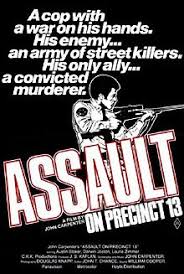
There’s something pleasant about a nice and tidy action movie: no emotional strings, little character involvement, and an ample body count combined with mounting destruction. Best of all is the sense of watching somebody accomplish something under a sort of trial by fire, be it the protagonists or the antagonists. “Assault on Precinct 13” is exactly what it’s made out to be: simple entertainment in the form of violence, and the end result is a typically Hollywood movie with few disappointments.

“Assault” opens with an undercover drug bust gone awry and the only survivor is Sgt. Jake Roenick (Ethan Hawke). Fast forward eight months and Roenick is now a burnt out cop working the graveyard desk shift at Precinct 13. On this particular night though, Precinct 13 is scheduled to close down permanently, and to cap the whole deal off, a busload of prisoners have to be kept at the precinct overnight until the roads clear. Among the prisoners is Marion Bishop (Laurence Fishburne), an organized crime boss, who had a number of dealings with dirty cops, led by Marcus Duvall (Gabriel Byrne). The one thing this group of dirty cops won’t let happen is for Bishop to reach trial and end all of their illegal activities. The result is a full out assault on the precinct and all of its inhabitants in the hopes of killing the key witness.

Granted, this movie is a remake of a 1976 movie by John Carpenter and almost the same overall movie, but what’s even more important is that this is basically just a remake of any old western “hold down the fort” kind of movie. Be it cops or Indians outside the safety of the fort, it’s still the same movie. Director Jean-François Richet’s remake modernizes the original story, giving it new action sequences and even (gasp) adding some new plot twists. Whether these plot twists are there for independent intentions or are merely there to differentiate from the original is a topic that I will ignore for the purpose of being polite. The movie does boast a nice supply of good, wholesome violence and provided you can ignore the convenient plot devices (dark and stormy night, forgotten tunnels, forest in the middle of Detroit, etc.) “Assault” ends up being a pretty solid piece of work. You don’t want to fool around with dirty Detroit cops, since they have more firepower than the army and better high-tech resources than the C.I.A.

Laurence Fishburne is playing the same ubercriminal that Alan Rickman made great in “Die Hard”, only this time the proportions of ruthless criminal to intelligent villain are verging on cartoonish. Gabriel Byrne is there, playing the overanalyzing leader, only this time, he seemed to be a little confused as to exactly what type of character he was supposed to playing; merciless killer one minute followed by a river of deep moral conflict and personal reflection the next. Maybe there were two different scripts; heck, that might explain the minor inconsistencies in the plot.
“Assault” is a pretty entertaining movie all around, especially if you enjoy some good gunfights, big explosions, and a solid film about good guys shooting up a bunch of bad guys.

Monday, December 30, 2013

Patience and Spontaneity

-->
Almost without argument, one could say that the heart of improvisation is in spontaneity; by it's very definition, improv is merely theater that is performed without a script, therefore, to paraphrase Huey Lewis (and the News), the “Heart of improv is still unplanned.” That's just the name of the game, as soon as you start planning stuff, and honestly trying to achieve what you've planned, it's no longer improvised theater, it's just plain theater. Improv teachers go to great lengths to achieve spontaneity and true artistic inspiration (because this is what improv really boils down to – you can do anything you want, so you need to be free to do anything you want.) Most of what is done, especially to beginning improvisers, is in the name of speed: Story, Story (Die), Dirty Hand Randy, New Choice, etc. are probably some of the most truly improvised games (at least in the short form sphere) because they are intended to move so quickly that the player doesn't have time to plan. You either just let your brain run wild and with abandon, or you get left behind.

The problem with this is it is essentially a crutch we hand to people: just move quickly and it will be improvised. The problem here is that experienced players don't need that crutch anymore – they are capable of stepping on stage and acting without thinking or pre-planning, only they have been trained such that they will step on stage and run so quickly through even the most complicated transactions that they don't really improvise any more. Generally speaking, this kind of speed is okay in the slam, bam, thank you ma'am world that is shortform, where the emphasis is not on artistic exploration but on entertainment, and where that kind of energetic, fast-paced scene work thrives especially well in “games”. But as you move into long form (where you do a scene that may last three minutes still, but you may have to come back to, or make run an entire thirty minutes (I've seen it done, nonbelievers)) that no longer has the gimmicks (or referee or MC to bail you out) that kind of speed works to your detriment.

Longform requires more patient, discovery-based improv, and as my mother and I can attest, you just can't enjoy the sights when Dad is driving past them at 70 miles per hour (a condition which I now believe may be genetic – sorry passengers). Give a group of new-to-longform improvisers a scenario (any scenario really), and they will be done with it in a blink. Give the same scenario to experienced improvisers, and they will take their time exploring every single, tiny moment, and not just tediously waiting for the next big thing to happen, but really enjoying themselves in the pace of normal life. This is where really improvisation lies: moving slow enough that you can actually enjoy and discover things about your partner, scene objects, or environment. A shortform improviser flows from his head, while a longform improviser flows from everything.

I saw some improv last weekend that definitely fits this bill: no one would argue that these were energetic improvisers, capable of editing with abandon, and fast, too. In thirty minutes they probably did 20 independent scenes, but it wasn't entertaining. Sure, the dialog was improvised (at least I hope it was, scenework that bad had better not been written out ahead of time and approved) but it was just manic (well that and nobody was working together, but that's a subject for a different essay all together). My point is this: scenes don't have to fly by and ninety eleven miles an hour to be interesting or even improvised. The easiest way to get yourself out of a “pre-thinking” mode is to truly focus on only the last thing that was said. All improv really should be is a series of reactions to different stimulus, just true, honest reactions. And that's the whole point of using speed as a training tool in the first place. Quick thinking, and just react. And don't rush, or you'll miss all that pretty scenery.

Monday, December 9, 2013

National Treasure


 Back in 2004, I used to write movie reviews for the USM student newspaper, the "Student Printz". Because I occasionally feel lazy, and it seems a shame that all of five people ever read these, I've decided to repost them here, in the original versions that I emailed to my editor, Noel, all those years ago.
At some point, the “green-lighters” in Hollywood will have to figure out that having Jerry Bruckheimer as a producer is not a sure-fire way to make a good movie. For example, “Coyote Ugly” – mediocre, “Pearl Harbor” – mediocre, “Pirates of the Caribbean” – excellent, and “National Treasure” – mediocre. “National Treasure” is like a distilled “Raiders of the Lost Ark”, such that the entertainment is watered down and the history concentrated for effect. Obviously built on the well tried formula for a family movie, “National Treasure” succeeds only as far as this formula will go, which means a few laughs, some mindless chase scenes, and a long, drawn out history lesson.

The movie is about Benjamin Franklin Gates (Nicholas Cage), the current descendent of the family Gates, which for the last 180 years has been searching for a treasure that was buried by our forefathers during the American Revolution. The treasure was started during the time of the Egyptian Empire, and as time progressed, the treasure was captured by different groups and expanded upon until the Knights Templar discovered it. This order slowly smuggled it over to the New World, where the Free Masons hid it from the British until such a time that it could be given to the entire world. But Gate’s former partner, Ian Howe (Sean Bean), intends to take the treasure for himself. Gate’s only option is to try and beat Howe to the treasure with the help of his nerdy sidekick Riley Poole (Justin Bartha) and a National Archives curator, Dr. Abigail Chase (Diane Kruger).

Now, I will even go on record to say when I first saw the trailers for this movie, I was groaning at the thought of a pitiful quasi-“Indiana Jones” movie. Even though that’s pretty much all that was accomplished, I was surprised to find that “National Treasure” was not as god awful as I previously took it for. Granted, the movie should have been wrapped up in ninety minutes instead of 120+ and nearly every plot twist is either to match the formula for an action movie or to prevent making the movie a history channel special on early American History. Regardless, Sean Bean and Harvey Keitel (as an FBI agent) are excellent, even in this cut and dry script and the rapport between Gates and Riley is often the only entertaining dialogue on camera. And in what was probably a last minute script change, the final treasure changes from “believing in your dreams” to some actual gold. If they hadn’t changed this part of the script, the corny factor would have shot through the roof and made the movie unbearable.

Provided you don’t mind the formula of the action movie, chances are you’ll really enjoy “National Treasure”. Sure the entertainment is mindless and the plot just a yard short of ludicrous, but when did that ever stop a movie from being worth a watch? “National Treasure” is entertaining enough, and if you just sit back and relax, you just might learn something.

Monday, November 18, 2013

Long and Short

I love shortform versus longform arguments – they usually fall down along these lines: shortform is popular, but shallow and hokey, and longform is more complex, but elitist and condescending. My friend has a great analogy that I'm going to invoke here, which is that shortform is like Lady Gaga, and longform is like Miles Davis. Now Lady Gaga (or really any large-scale, arena rock, top 40 artist) is “quick, fun, and the masses love it”. Lady Gaga is a far-out character in her own right, she has, it can be argued, built a majority of her following on her ostentatious and outrageous approach to fashion and self. (Fine, complain about the inherent chauvinism in that sentence if you must, but Gaga has built an empire on being a strange weirdo as much as Katy Perry has on being the bubble-gum girl next door, or any rapper in history has on being a from-the-hood “gangsta”.) Gaga's music (like Perry or Kings of Leon, et al) is not complex – it is fairly derivative and repetitive, but damn if it isn't catchy (I spent the better part of a week in a waiting room for a court case the summer that “California Girls” hit big, and damned if I didn't hear Perry crooning about melting Popsicles once an hour, and still enjoyed it.)
Now, the converse is that longform is more like Miles; its “complex, difficult, and there are a lot of people that can't appreciate it.” Miles probably never wanted (or intended) to create art that stood on the shoulders of his own persona, and probably just wanted the music to stand on its own. But his (very valid) point is that longform has (at the very least) the perception of being kind of art for art's sake. In another word: masturbatory. I've spent a number of nights in longform shows where I'd wager somewhere between 25-50% of the audience was other improvisers, or improv students. (At some shows, it may be even higher.) I've also spent nights in shortform shows that were completely occupied by people who weren't just non-improvisers, but had never been to any improv show before. Miles Davis' Kind of Blue (the best selling jazz album of all time) has only sold 4 million copies, whereas Gaga's The Fame has sold over 12 million, Kings of Leon's Only by the Night has sold 6.2 million, and Katy Perry's Teenage Dream has sold 5.5 million, in addition to 30 million copies just for the singles (outside of album sales), and is only the second artist in history to have an album spawn five singles (behind Michael Jackson).
Now the argument of Gaga v Davis is a (unfortunately) very manifest one, which is that longform tends to be a little self-obsessed. Self-important, even. Some of the more well-known longforms are very artistic, can be very “modal jazz”, obtuse, and self-aggrandizing, such as the Harold, which is such a dense form, that it is surprising that anyone ever does it well. But to make the assumption that all longform is weird and onanistic is to miss the point of longform – it is not impenetrable by nature, but by nurture. Longform is more complex than shortform, both for players and audience, and can be quite difficult, but can also be very deep, meaningful, and painfully entertaining. I have seen countless shortform shows that are just as self-important, self-aggrandizing, boring, and dense as I have longform shows – it's not the form that makes the show, it is always the improviser that makes the show. If you have elitist, vapid, and over-wrought players, you're going to have an elitist, vapid, and over-wrought show, regardless of whether you're doing “Freeze Tag” or the “Three Mad Rituals”.
Now, let's go back to music briefly. Fine, Gaga outsold Davis by 8 million copies, even with Blue having a 50 year head start. But let's compare: remember those numbers above for a bunch of the current big artists? Well, they don't even score on the list of the best selling albums – Pink Floyd's Dark Side of the Moon is considered one of the best albums ever made, and has sold a whopping 50 million copies world wide, and is the second best selling album of all time (behind MJ's Thriller). And Moon is no Fame – it is very artistic, groundbreaking in sound design as well as songwriting, uses interview clips to break up songs, and is a dense (and also entertaining) album, yet still outsold Gaga more than 4 times over.
This tells me that audience's don't care about art/entertainment so much; “I may not know much about art, but I know what I like”. Sure, you may get some people who'd prefer to watch a few games than invest in a whole involved piece, but the fact remains that well-executed trumps for-the-masses every time. Look at movies like Kazaam to see something that was intended to be easily accessible, lowest common denominator popcorn fare, and is universally reviled. (As a fun project, go look at the lowest scored films on Metacritic, and, sure, you'll see Date Movie, but you'll also see Adventures of Pluto Nash (with Eddie freakin' Murphy), which also has the dishonor of being one the biggest flops in movie history. That list is a veritable rouge's gallery of cinematic failure in commercial film-making aspirations.) It is not by virtue of the medium, but the artist that makes the art impossible to watch.

Monday, October 28, 2013

The Grudge


Back in 2004, I used to write movie reviews for the USM student newspaper, the "Student Printz". Because I occasionally feel lazy, and it seems a shame that all of five people ever read these, I've decided to repost them here, in the original versions that I emailed to my editor, Noel, all those years ago. 
Horror long ago became the bastard child of cinema: the desire to make truly frightening movies like the original “Night of the Living Dead” or “Psycho” is consistently traded off to put together movies that are designed to just jump out at you to scare you. Indeed, it seems that moviegoers are almost masochistic; these types of horror movies do surprisingly well in the box office and Hollywood does not hesitate to keep coming up with new ways of saying ‘Boo!’ “The Grudge”, the newest such entry into the fraternity of scary movies is certainly no exception. Without a doubt “The Grudge” will succeed in making most people jump, but it really just falls short of being truly frightening.

“The Grudge” follows the story of Karen Davis (Sarah Michelle Gellar), an American social worker living with her boyfriend in Tokyo. When one of her coworkers fails to show up for work, Karen is asked to cover her patient for a day. Karen arrives at the house only to find her patient all alone and the house in a complete state of disarray. She is hardly in the house for more than an hour before she hears strange noises coming from a taped up closet in the house. She opens the closet only to find a little boy, a book and a black cat. She’s manages just another few minutes before she runs into something far scarier than a spooky little boy: a ghost composed of enough hair to clog a manhole cover. Her brush with the ghost prompts Karen to unravel the mystery behind the strange occurrences in the house.

The story is told in a nonlinear style, not so much to give us new or necessary information or help advance the plot, but instead just to provide more opportunities for ghosts to kill people in different ways. Among the many victims in the movie are the couple who purchased the house, the patient’s daughter, and a police officer trying to find out how three of his partners died while investigating a murder in the house. The only story necessary to the plot is the one involving Peter (Bill Pullman), who is directly tied to the formation of the curse, and is the only one who doesn’t die from the “grudge”. The movie is a bit of an oddity: being based on a Japanese movie is pretty standard, but this is the first one to be directed by the same director from the original, Takashi Shimizu.

“The Grudge” has all the familiar horror conventions and enough of them to make the movie pretty scary: plenty of dark rooms, corners for ghosts to hide behind, and enough ghost fodder who are more than eager to go investigating strange noises. Japanese ghosts are nothing if convenient though: they call you on the phone to let you know they’re coming, they visit you at your workplace, and they even stash bodies in the attic for the police to find. Though the plot tends to drag in a few places, the scary and spooky events are paced well enough to at least keep you entertained.

“The Grudge” succeeds rather well as your typical October scare fest, but more than likely no one will remember it when they’re making their movie list next Halloween. Once you figure out how it’s pulling your strings, it loses its potency dramatically. If you’re in the mood for a good scare this October, “The Grudge” should meet your needs sufficiently, just don’t plan on being honestly frightened.

Monday, October 7, 2013

I Hate Improv Class

-->
(Author's note: I wrote this essay around February 2009.)

Since moving to San Diego, my once weekly fix of improv with my long form group has yet to fully satiate my improv hunger. I decided to sign up for classes at the local improv house. It's a short-form in the style of Comedy Sports kind of place, and even though I don't particularly want to do that kind of 'prov again, I was so hungry to do some improv, any improv, I was willing to go back to “class one” again. Additionally, I'm hoping that I can get a place performing at the theater regularly when it's all over with, and get some stage time and start building a group of improv friends to hang out with. (What can I say? I'm lonely.)

I signed up for classes no problem (though, to my surprise, almost the same price as a session of classes at the iO in Chicago, and only six weeks instead of eight), and as I was driving to the theater, I noted a distinct knot in my stomach. I was nervous. I was dreading going to class - I was honestly afraid of getting up on stage and making a damn fool out of myself. Now, I have never been afraid on stage. I have proudly stepped on to many stages and have been animals, people getting sexually molested, doing the sexual molestation, and inanimate objects (that are being used for sexual molestation). But this class, and as a matter of fact, every single class or workshop I have ever taken, I feel nervous right before the first one. I am constantly afraid that this class is the one where I will completely screw up, and no one will ever want to improvise with me ever again. And, I would argue that this nervous feeling has gotten worse the longer I've been doing improv.

While most people would say that after they've been doing it longer, they've gotten more comfortable because they're more experienced. For me though, I feel that the longer I've been doing improv, the less of an excuse for screwing up I have. When I took my first class at the iO in Chicago, I was bold as hell (probably too much, my teacher Andy had me rope it in a little bit) because at that point I could have screwed up, and just said: "Oh well, I've only done improv at college". Now though, if I screw up, people can only say: "I thought this guy did improv in Chicago!"

A failure on stage is almost always the result of no support, etc. But I can't fault new players for messing up. A flub now will definitely support the theory that I have no business doing this. As a result, I find myself working ten times as hard for everything, just to keep my head above water (it also doesn’t help that I’m a bit of a perfectionist, and I’ve only liked maybe 5% of all the improv I’ve ever done). I feel the need, the absolute life-ending need, to prove myself every time I’m around a new group, and especially a new teacher/coach. I hate improv class for the exact opposite reason that people take classes: wanting to prove that I’m good enough. I’m a student! Shouldn’t I feel comfortable enough to make mistakes in class?

Unfortunately, I now wear my Chicago improv tutelage like a weight around my neck.

Monday, September 16, 2013

The Summer

 
Back in 2004, I used to write movie reviews for the USM student newspaper, the "Student Printz". Because I occasionally feel lazy, and it seems a shame that all of five people ever read these, I've decided to repost them here, in the original versions that I emailed to my editor, Noel, all those years ago. 

Though Hollywood is not known for consistently releasing good movies, most visitors of the Cineplex can at least look forward to the summer movie crop for some big budget, special effects-ridden movies to break the summer heat. Usually, even with a big budget, the movies can actually surpass the “eye candy” mark: the summer is where we got movies like Back to the Future, Star Wars, American Pie, Men in Black, Spider-Man and Raiders of the Lost Ark. But this summer, we were instead treated to not just a few, but an entire slew of empty Hollywood spectacles. While copious special effects can still leave an amazing movie (a la The Matrix), there comes a point when you need some meat with your popcorn.
For example, the summer opener, Van Helsing was little more than 2 hours of loosely strung together special effects and a hefty price tag ($175 million). The acting was mediocre to bad, and the plot was so bad that it seemed to have been written over a few hours. Two weeks later was the even larger budgeted Troy, starring Brad Pitt and Eric Bana, which was without a doubt modern cinema at its worst. First, you have really neat characters, with long, well explained back stories, then set them in a really neat story, and two and a half hours later, all you’ve done is a few short action sequences. With everything the movie had going for it, they ended up saying absolutely nothing, and doing next to nothing.
Of all the special effects extravaganzas, The Day After Tomorrow was without a doubt the most enjoyable, yet still ended up being very disappointing. Directed by Roland Emmerich (of Independence Day), the movie details the events of a storm spanning the entire globe, therefore requiring special effects for nearly half the movie (and not always good FX either). The characters were fun to watch and the plot was interesting, but the movie was so similar to Independence Day that it seemed as though we weren’t seeing anything new.
Perhaps the worst movie all this summer was Catwoman, which was basically a ninety minute movie whose sole merit was a scantily clad woman (in fact a male body double). The film showed complete ignorance of the source material (that is the DC comic character Catwoman). The director had the absolute brilliance to use the exact same song anytime Catwoman was about to do anything and make sure that Halle Berry wore the most form-fitting outfit for no particular reason. The real down side is that Berry was actually played a man (not kidding) during all the action and fight scenes.
The big word to sum up this summer at the movies would be disappointment. Though Hollywood did deliver with a few good movies we were all looking forward to (like Shrek 2 and Spiderman 2), nearly everything else from start to finish fit in the apparent summer movie theme of lackluster entertainment. This summer’s movies were almost all big budget special effects let downs, unoriginal adaptations and astonishingly unfunny, lame “comedies”. Though we can’t expect Hollywood to deliver funny, entertaining, special effects blockbusters all the time, summers like the past one remind audiences just how bad Hollywood can be.